You’re pricing a Thailand trip and every hostel photo looks like a 2009 gap-year fever dream: bunk beds stacked to the ceiling, one bathroom for forty people, a common room that smells like spilled beer.
So you’re leaning hotel, even though the budget math hurts. Here’s the honest hostel vs hotel Thailand comparison: not a hostel sales pitch, not a hotel puff piece. For the bigger picture on where to base yourself, start with our complete Koh Tao guide.
The short version: modern hostels aren’t what you’re picturing, hotels genuinely win for a specific kind of traveller, and there’s a middle option most people don’t know to look for. This guide covers all three honestly, then tells you exactly who should book what.
For most solo and social travellers in Thailand, a hostel wins on cost, community, and local knowledge: modern hostels have pod-style beds with privacy curtains, lockers, and AC, not 2005-style dorm chaos. Hotels win for couples wanting full privacy, light sleepers, and business trips. The honest middle ground: a private room inside a social hostel, which gets you both.
Table of Contents
The Real Price Gap: Hostel vs Hotel in Thailand
On an island like Koh Tao, a hostel dorm bed runs roughly 300 to 1,000 THB in low season and 500 to 2,000 THB in high season, depending on the hostel. A budget hotel room (the kind with a double bed, a fan or basic AC, and not much else) starts around 600 to 1,000 THB a night in low season and climbs well past 1,500 THB in high season, and that’s for one person or two splitting the cost. A mid-range hotel with a pool and a proper breakfast buffet is a different budget entirely, often 2,500 THB and up per night on an island where everything already carries a boat-shipping premium.
The gap compounds over a real trip. A week in a hostel dorm plus scooter and street food sits close to 10,500 THB shoestring, or 17,500 to 21,000 THB with a scooter and a few drinks. Full numbers in our Koh Tao budget guide. The same week in even a budget hotel, split between two people, still adds several thousand baht on the room alone, before you’ve paid for a single meal or activity.
None of this is Wonderland pricing. These are general island ranges, and they move with season the same way everywhere in Thailand does. The hostel vs hotel Thailand price gap isn’t marginal. For a solo traveller, it’s often the difference between a 2-week trip and a 5-week one.
What Modern Hostels Actually Are (Not the 2005 Stereotype)
Modern hostel dorms in Thailand are built around pod-style beds: each bunk is its own alcove, built into the wall or frame, with a privacy curtain that actually closes, a reading light, and a plug socket. Close the curtain and you’ve got a private pocket of space even in a shared room. That’s a different product entirely from the flimsy metal bunk bed most people picture when they hear the word “hostel.”
Lockers are standard, AC is standard, and the room itself is designed for actual sleep. Social energy stays in the common area, not in the dorm. Some hostels also run female-only dorms for travellers who want that option, alongside the standard mixed rooms. None of this is a luxury upsell. It’s just what a hostel building looks like when it’s been designed in the last few years rather than repurposed from an old guesthouse.
The stereotype (rows of exposed bunks, one grim shared bathroom, zero privacy) still exists at the bottom of the market, same as a bad motel exists at the bottom of the hotel market. But it’s no longer the default. Our ranked guide to Koh Tao’s best hostels breaks down which properties actually deliver on this and which don’t.
Key Takeaway
If your mental image of a hostel dorm is a bunk bed with no privacy, you’re picturing a hostel from fifteen years ago. Pod beds, curtains, lockers, and AC are the current standard, not the exception.
Where Hotels Genuinely Win
Hotels win outright for a few specific travellers, and it’s worth saying so plainly. Couples wanting total privacy (no shared spaces, no small talk required, just a door that locks and nobody else’s schedule to work around) are better off in a hotel room, full stop. A private hostel room gets close, but a hotel removes the shared-building element entirely.
Light sleepers who are sensitive to any noise, any footsteps in a corridor, any doors closing at odd hours, tend to do better with a hotel’s isolation, even a quiet social hostel’s private room. And business trips, where the point is a desk, reliable Wi-Fi, and zero interaction with strangers before a work call, are a hotel’s home turf, not a hostel’s.
If any of those describe your trip, a hostel isn’t the wrong choice out of ignorance. It’s just not built for what you need. That’s a legitimate answer to the hostel vs hotel Thailand question, and pretending otherwise would be a worse guide, not a better one.
Where Hostels Win
Hostels win for solo travellers, for anyone travelling on a real budget, and for anyone who wants their trip to include people they haven’t met yet. A hotel room is a closed door. A hostel common area is where you find out who else is on the island, what they’ve done that day, and whether anyone wants to split a boat trip to Koh Nang Yuan tomorrow morning.
Reception at a good hostel is also just better local knowledge than a hotel front desk usually offers: staff who’ve lived on the island for years, know which scooter shop won’t scam you, and can book your first dive course the night before. Our solo travel Koh Tao guide covers exactly how that plays out day to day.
And there’s the cost side already covered above: a hostel dorm frees up budget for the diving, the boat trips, and the extra week that a hotel room would have eaten. For social, budget-conscious, or first-time solo travellers, hostels aren’t the compromise option. They’re the better one.
The Hybrid Answer: Private Rooms Inside a Social Hostel
Most people frame this as hostel vs hotel in Thailand: pick one. But there’s a third option that solves the actual trade-off: a private room inside a hostel. You get your own space and your own door, and you’re still five metres from a common area full of people, a pool, and someone to talk to at breakfast if you want it.
This is exactly the gap Wonderland’s private rooms are built for: couples who want their own bed and bathroom but don’t want to disappear into a hotel with no atmosphere, or solo travellers who’ve done the dorm circuit and want privacy without losing the social layer entirely. It’s not a compromise between hostel and hotel. It’s both, at the same time, for less than a comparable hotel room.
The test is simple: if the appeal of a hotel is privacy and the appeal of a hostel is people, a private hostel room gives you the door that locks and the pool with company by it. For a lot of travellers weighing hostel vs hotel Thailand, this is the option nobody mentioned until now.
Most social hostels on Koh Tao, including Wonderland, run a handful of private rooms alongside the dorms. Worth checking before you assume hotel is your only privacy option.
Cost Math: A 2-Week Thailand Trip, Hostel vs Hotel
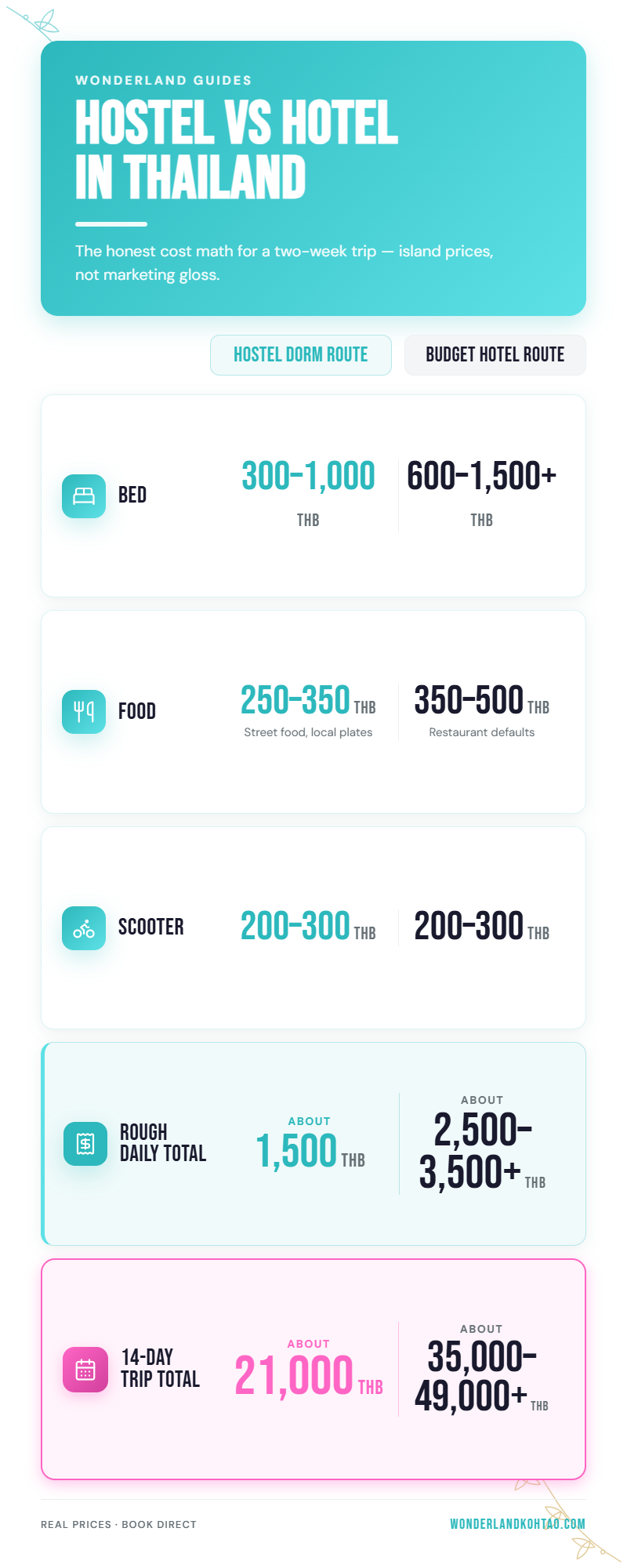
Here’s the honest delta over a realistic two-week trip, using the same daily structure as our budget guide’s shoestring-to-mid-range breakdown. These are island-level ranges, not any single property’s rates, and they’ll shift with season and location.
| Item (per day) | Hostel dorm route | Budget hotel route |
|---|---|---|
| Bed | 300 to 1,000 THB | 600 to 1,500+ THB |
| Food | 250 to 350 THB (street food, local plates) | 350 to 500 THB (more likely restaurant defaults) |
| Scooter | 200 to 300 THB | 200 to 300 THB |
| Rough daily total | ~1,500 THB | ~2,500 to 3,500+ THB |
| 14-day trip total | ~21,000 THB | ~35,000 to 49,000+ THB |
That gap (often 15,000 to 25,000+ THB over two weeks) is roughly a flight home, another week on the island, or a full Open Water dive certification with money left over. It’s not that hotels are bad value for what they offer. It’s that a hostel dorm frees up a genuinely large amount of a backpacker’s total trip budget. Full daily breakdowns, including what a dive day adds, are in the Koh Tao budget guide.
Privacy and Community. Pick Both.
Private rooms right next to a common area full of people, and for families, Bill the Lizard with its own bathroom: the middle ground between hostel and hotel that most travellers don’t know to look for.
Check AvailabilityHow to Pick a Good Hostel (So You Don’t End Up in the Stereotype)
The hostel-vs-hotel decision only goes badly if you pick a bad hostel. A few green flags: recent photos of the actual dorm beds (not just the pool), mention of privacy curtains or pod-style beds, AC confirmed in every room not just “some,” and reviews that mention staff by name, that’s usually a sign of an actual community, not just a bed factory.
Red flags run the other way: photos that are all common-area and zero dorm interior, vague language like “traditional hostel experience,” no mention of lockers or AC, and reviews split hard between “best trip of my life” and “worst sleep of my life” with nothing in between; that split usually means a party hostel got listed as a general one.
Also worth deciding upfront: do you want “social” or “party”? They’re not the same thing, and conflating them is how people end up in the wrong bed. A social hostel has a common area and organised activities but quiet dorms after a set hour. A party hostel is loud all night, every night, by design. Our best hostels in Koh Tao guide ranks exactly this distinction across the island’s options, including which ones are honestly built for an 18 to 35 party crowd and which aren’t.
Hostel vs Hotel Thailand: FAQ
Hostels, by a wide margin. A hostel dorm bed typically runs 300 to 1,000 THB a night versus 600 to 1,500+ THB for even a budget hotel room. Over a two-week trip that gap regularly adds up to 15,000 to 25,000 THB, enough for an extra week on the island or a full dive certification.
No, only at hostels that specifically enforce an 18 to 35 age policy, which tend to be the dedicated party hostels. Social hostels skew wider, and plenty of guests at social properties on Koh Tao are in their 30s and beyond. Age matters less than picking a hostel that matches your energy: social, not party.
Yes, at a well-run social hostel. Lockers are standard for valuables, staff are on-site, and a strong common-area culture means you’re rarely anonymous; people notice if something’s off. The bigger practical safety concern on an island like Koh Tao is scooter accidents, not hostel security.
Regularly, usually in a hostel’s private room rather than a shared dorm. It gets couples their own space and bathroom while keeping access to a common area, pool, and social scene a standalone hotel wouldn’t offer. It’s a common middle path between hostel vs hotel Thailand, not an edge case.
Most social hostels run a small number of private rooms alongside their dorms, usually at two to four times the dorm-bed rate. They’re generally still cheaper than a comparable hotel room and come with access to the hostel’s common areas, pool, and activities: the hybrid option most people don’t realise exists until they ask at reception.
Try the Social-Not-Party Version
Hostel vs hotel in Thailand comes down to what your trip actually needs, and for most solo and social travellers, that’s a hostel built for actual sleep, not the 2005 stereotype. Pod beds, privacy curtains, lockers, AC, and a common area that does the work of introducing you to your next travel friend.
Wonderland is exactly that middle ground: social, not party, with private rooms for anyone who wants both the community and the door that closes. And whichever hostel you land on, check the direct price before you book through a third-party site.
Your stay funds free education through Horizon Asia
Book Direct & Save
Book Direct & SaveBest price guaranteed. Dorms and private rooms both available: pick the setup that fits your trip.
Keep Reading
Best Hostels in Koh Tao: ranked honestly→ Koh Tao Budget Guide: what everything actually costs→ Where to Stay in Koh Tao: neighbourhood guide→ Solo Travel Koh Tao: the complete guide→ Hostel Rooms in Koh Tao: pods, privates, and what’s included→ Koh Tao vs Koh Phangan: the honest comparison→ The Complete Koh Tao Guide (hub)→